How to Use a Mandoline Slicer Safely, Step by Step
August 27, 2026
The 30-second version: pick the right blade, set the mandoline on a damp towel so it cannot slide, cut one flat edge on the food, spear it on the hand guard, glide with light even pressure, and stop while the guard can still grip.
A cut-resistant glove is the insurance layer. That is the entire skill; everything below is the detail that keeps it consistent and keeps you out of the emergency room.
And the emergency-room part is not a figure of speech. Mandoline slicers send an estimated 16,800 Americans to the ER every year, according to a kitchen injury audit of federal NEISS data, and federal injury tracking has watched slicer-and-chopper cuts climb for two decades. A recent viral cucumber-salad trend added its own documented ER trip. Every one of those injuries has the same anatomy: bare fingers, a nearly finished vegetable, one more pass.
Before You Start: The Three-Item Safety Setup
- The hand guard. It comes in the box for a reason. The prongs impale the food, your hand holds the guard, and nothing soft ever crosses the blade line. If your mandoline’s guard has vanished, a universal replacement fits most flat models.
- A cut-resistant glove, rated A5. The ANSI/ISEA 105 standard grades gloves from A1 (withstands about 200 grams of cutting force) to A9 (over 6,000). Kitchen pros put mandoline and grater work at A5 and up. Two caveats: cut-resistant is not cut-proof, and a knit glove should be worn under a food-safe disposable glove when it touches food directly.
- A stable base. Set the mandoline’s feet on a cutting board with a damp paper towel or non-slip mat underneath. A slicer that shifts mid-stroke is a slicer you chase with your palm.
How to Use a Mandoline, Step by Step
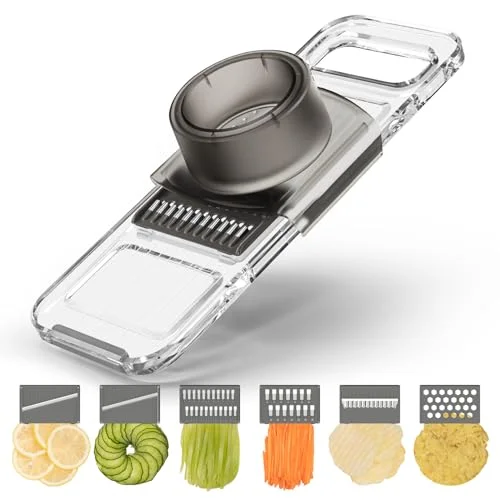
- Choose the blade and thickness. Straight blade for slices, julienne for matchsticks, crinkle for ridged cuts. On a multi-blade model like the KEOUKE transparent mandoline, swap the platform insert; the spares live in the storage box, not loose in a drawer.
- Anchor the board. Damp towel under the cutting board, mandoline feet on the board, over the bowl or a plate if the model is handheld.
- Prep the food. Wash, peel if the recipe calls for it, and cut a flat edge: halve the onion, square off one side of the potato. A flat face sits flush against the platform from the first stroke, so slice one is as even as slice twenty.
- Load the guard. Push the prongs firmly into the flat side of the food. Your fingers wrap the guard’s dome, never the food itself.
- Glide, don’t press. Run the guard down the platform with light, even pressure and let the blade set the pace. If you are forcing it, the blade is dull or the food is wrong for the tool.
- Keep your eyes on the pass. Mandoline injuries are attention injuries. No phone, no conversation-with-eye-contact, no catching slices mid-air.
- Stop early, finish with a knife. The moment the food gets too short for the prongs to hold, you are done. Knife-finish the nub or throw it in the stock bag.
Thickness Settings by Dish
Numbers beat guesswork. These settings come from tested recipes and translate across brands:
| Dish | Thickness | Blade |
|---|---|---|
| Potato chips | 1 to 1.5 mm | Straight, thin |
| Gratin / scalloped potatoes | 1.5 to 3 mm | Straight |
| Cucumber salad | about 2 mm | Straight or crinkle |
| Tomato slices | 3 mm | Straight, sharp |
| Zucchini noodles | 3 mm | Julienne |
| Slaw and shreds | coarse shred | Shredding blade |
| Fries | 5 to 8 mm | Thick or julienne |
| Garlic, radish accents | fine grate / thin | Grating insert, guard always |
One habit worth stealing from restaurant kitchens: slice one test piece, check it, then run the batch. Adjusting after twenty slices helps nobody.
What to Slice, and What to Keep Off the Blade
Mandoline territory: potatoes, cucumbers, onions, carrots, radishes, zucchini, cabbage, fennel, beets, apples, pears, citrus for garnish, and firm cheeses. (For shredding cheese rather than slicing it, see our rotary vs. box grater comparison.)
Keep off: cooked eggs, cured and deli meats, soft cheeses, and very ripe fruit. Soft foods compress and smear rather than slice, they clog the blade, and their slipperiness invites freehand improvisation, which is how the ER statistics grow. Fresh mozzarella wants a knife; prosciutto is already sliced.
Tricky-food adjustments: firm tomatoes take a light back-and-forth shimmy instead of one push. Round slippery things like Brussels sprouts stay on the guard, period. Halve onions pole to pole first so the layers hold together against the platform.
A Contained Alternative If the Open Blade Isn’t for You
Some cooks never make peace with an exposed blade, and there is a structural answer: chopper-style mandolines enclose the blade in a lidded container. You press the lid, the cut happens inside, and slices drop into the box instead of toward your hand. The KEOUKE 12-in-1 chopper and mandoline works this way: eight slicing and chopping inserts, a hand guard for the open passes you still choose to make, and a container that doubles as storage for the whole kit. Same paper-thin results, no open blade line between you and dinner.
Cleaning and Storing Without a Souvenir Cut
- Rinse the platform and blade the moment you finish; dried starch takes scrubbing, and scrubbing near an edge is where cleanup cuts happen.
- Use a brush, never a sponge. A sponge molds your fingertips around the blade; a brush keeps them behind bristles. Stroke away from the edge.
- Dishwasher-safe models earn the label: detach the pieces and let the machine do the risky part.
- Store with the guard docked on the platform and spare blades in their case. A loose mandoline blade in a utensil drawer is a trap with a delay timer.
Used with the guard, a glove, and the stop-early rule, a mandoline is not a dangerous tool; it is the cheapest way home cooks get restaurant-even slices. Respect the last inch and it will never remind you why the rules exist.
How We Sourced These Numbers
- Kitchen injury audit of federal NEISS data: the estimated 16,800 US emergency-room visits a year from mandoline slicers, derived from the CPSC’s National Electronic Injury Surveillance System.
- The New York Times, Cooking Tools Add Convenience, and Danger: CPSC figures on slicer-and-chopper ER visits climbing from 12,001 in 2001 to 21,699 in 2011.
- ANSI, the ANSI/ISEA 105-2024 hand-protection standard: the A1 to A9 cut-resistance scale and the gram-force thresholds behind our A5 recommendation.
- Serious Eats, the classic potato gratin recipe: the 1/16-inch (1.5 mm) gratin slice that anchors our thickness table.
- Milk Street, what not to run through slicing tools: the keep-off list of eggs, cured meats, soft cheeses, and very ripe fruit.
- Eater, the cucumber-salad mandoline warning: the documented ER visit behind the viral TikTok trend.
Where a thickness setting differs by machine, we give the range and the dish it serves rather than one brand’s dial number.
Frequently Asked Questions
Do I really need to use the hand guard on a mandoline?
Yes, every pass. The guard's prongs grip the food so your fingertips never travel toward the blade, and it presses food flat for even slices. Nearly every mandoline injury happens during unguarded passes, usually on the last inch of food.
What cut-resistant glove level do I need for a mandoline?
ANSI A5 or higher. The ANSI/ISEA 105 scale rates gloves A1 to A9 by the force needed to cut through; A5 gloves withstand 2,200 grams or more, which suits mandoline and grater work. Remember that cut-resistant is not cut-proof: the glove buys reaction time, it does not license careless passes.
How thick should I slice potatoes for chips versus gratin?
Potato chips want 1 to 1.5 mm, thin enough to crisp through. Gratin holds together best between 1.5 and 3 mm, depending on how defined you want the layers. Anything destined for the fryer as a fry belongs at 5 mm or more.
What foods should you never put on a mandoline?
Skip cooked eggs, cured meats, soft cheeses, and very ripe or soft fruit. They compress, smear, or tear instead of slicing cleanly, and slippery foods invite exactly the unguarded improvising that causes injuries. Firm vegetables, firm fruits, and firm cheeses are mandoline territory.
Can you slice tomatoes on a mandoline?
Yes, if they are firm and your blade is sharp. Use a gentle back-and-forth shimmy rather than one hard push, and set the thickness around 3 mm so the slice supports itself. Very ripe tomatoes belong with a serrated knife instead.
Is a dull mandoline blade safer than a sharp one?
No, the opposite. A dull blade needs extra pressure, and extra pressure is what makes hands slip. A sharp blade glides through with light force, which keeps the pass controlled. If you find yourself leaning into the stroke, the blade is telling you something.
What do I do with the last inch of food?
Let it go. When the piece gets too small for the guard's prongs to grip, drop the remainder on a cutting board and finish with a knife, or save it for the stockpot. The last nub is where fingers drift closest to the blade, and no slice is worth it.
How do you clean a mandoline without cutting yourself?
Rinse immediately after use, before starch and juice dry on. Scrub with a brush, always stroking away from the cutting edge, never a sponge that wraps your fingers around the blade. Dishwasher-safe models make this even simpler: detach the blade and let the machine handle it.
Slice even, keep every fingertip
KEOUKE Transparent Mandoline Slicer: 6 interchangeable blades from thin slice to fine julienne, a non-slip finger guard, and a storage box that keeps spare blades out of the drawer shuffle.
Shop on Amazon